A Wide Frame or a Tight Crop for an Aerial Photograph?
Choose a wide frame or tight crop for an aerial photograph by matching context, visible detail, and sense of scale to what you want viewers to notice.
The most common mistake with a wide frame or tight crop for an aerial photograph is choosing by drama alone: the broad view feels grand, or the close view looks graphic, so one wins before the subject has a chance to speak. The cost is a frame that hides the very thing viewers need—either the setting that explains a pattern or the detail that makes it legible.
Instead, ask what the viewer must understand first. A wide frame gives a subject room to relate to its surroundings. A tight crop concentrates attention, but can make a familiar place feel abstract or larger than it is. The right choice depends on the photograph’s job, not on a rule that one framing style is more compelling.
What should the viewer notice first?
Start by naming the photograph’s main point in plain language. Is it “a settlement beside open farmland,” “a road cutting through a forest,” or “the repeating geometry of rooftops”? If the sentence needs the surroundings to make sense, lean wide. If the subject’s pattern or texture carries the meaning on its own, consider a closer frame.
Then look at the image at the size people are likely to see it. On a phone, fine lines and small structures can merge. A crop that reads clearly on a large monitor may become an undifferentiated patch at a smaller size. Conversely, a wide view reduced to a thumbnail may lose its central subject altogether.
- Choose wide when context is the point. Keep enough surrounding land, water, or built environment to show where the subject sits and what it relates to.
- Choose tight when a visible pattern is the point. Let the repeated forms, edges, or textures fill more of the frame, provided they remain recognizable at the intended display size.
- Keep some breathing room when orientation matters. A little space around a feature can help viewers locate it without making the subject feel lost.
- Crop more firmly when distractions compete. Empty parking areas, an unrelated shoreline, or a bright corner can pull attention away from the subject.
These are starting points, not fixed categories. A broad photograph can still emphasize one feature through placement, contrast, or shape. A tight crop can retain a clue to location at its edge. The useful question is whether that clue earns its space.
When does a wide aerial frame fit best?
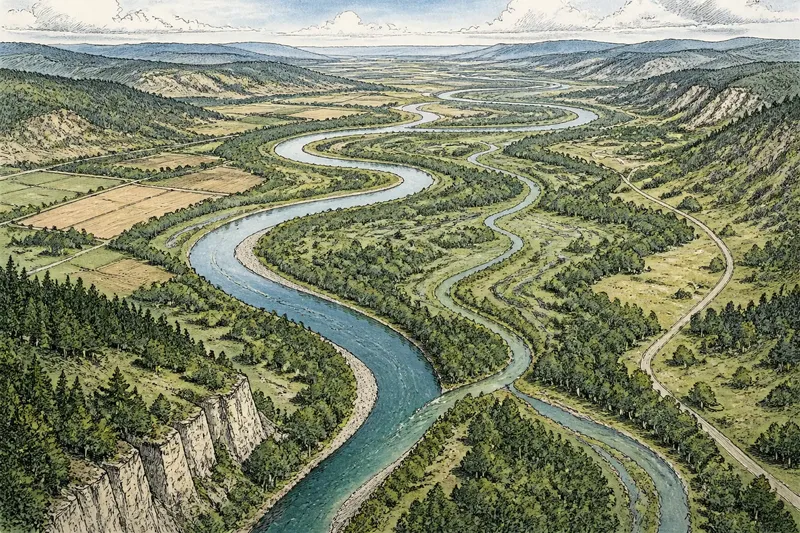
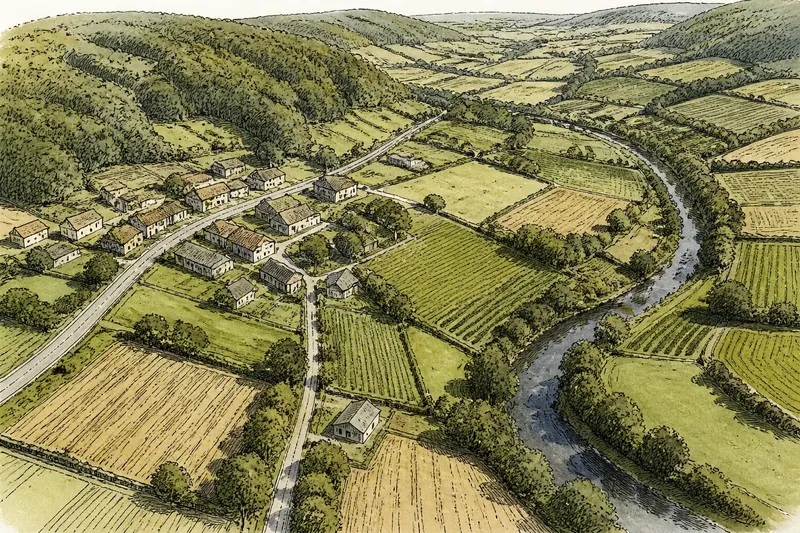
A wide frame suits a subject whose identity depends on relationships. For a town, the surrounding fields and roads may explain its position. For a mountain valley, the slopes, streams, and settlement pattern can give the main feature a sense of setting. Pulling in too close may leave a viewer with attractive shapes but no reason to understand them as a connected place.
Wide framing also helps communicate scale through comparison. A small building beside a broad field reads differently from the same building isolated in a close crop. Including a familiar feature—such as a road junction, tree line, or cluster of houses—can give the eye a useful reference without turning the photograph into a diagram.
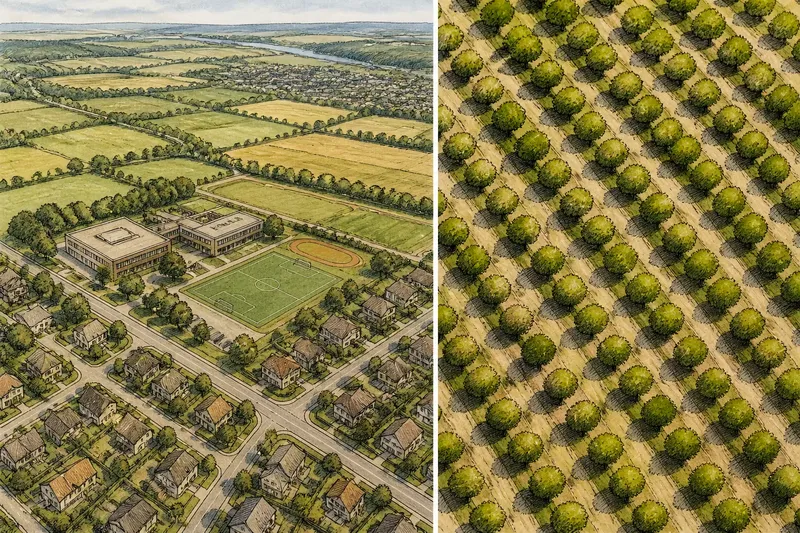
Say you are composing an aerial view of a school beside a sports field and a residential block. If the intended point is how the school fits into the neighborhood, keep all three elements in frame and leave enough street pattern to connect them. The expected result is a viewer who can read the school as part of a larger arrangement, rather than mistaking it for the whole subject.
Wide does not mean “include everything.” A frame crowded with unrelated features can flatten the hierarchy. Check the corners and edges: if they add no context, direction, or scale, they may be taking space from the main relationship. A modest trim can clarify a broad composition without converting it into a close study.
When does a tight crop make more sense?
A tight crop fits when the subject is made of details that disappear in a broad view. Rows of orchard trees, roof patterns, or the branching lines of a field can become visual noise when they occupy too little of the frame. Bring the crop in until the important forms are easy to distinguish, while keeping enough surrounding clues to prevent accidental ambiguity.
Close framing changes scale. A patterned surface can seem monumental when its boundaries are removed, and an ordinary arrangement may begin to look almost abstract. That effect can be useful for a photograph about rhythm, texture, or repetition. It is less useful if viewers are meant to judge the feature’s size or understand its relationship to nearby land.
Pay special attention to edges. A crop that cuts through a road, building, or shoreline can look intentional when the cut supports the composition. If it appears accidental, viewers may wonder what has been left out. Try shifting the frame so the edge either passes cleanly through an area of low interest or preserves the complete shape that matters.
There is also a practical limit: cropping cannot create detail the original image does not contain. If a small feature is already soft or indistinct, enlarging it may make the weakness more obvious rather than making the subject clearer. In that case, a wider composition with a readable surrounding pattern may be the stronger choice.
How should you decide between a wide frame and a tight crop?
Does the subject need its surroundings to make sense?
If yes, keep a wide frame and retain the landmarks that explain the subject’s position. If no, test a closer crop that gives its shape or texture more room.
Are the details readable at the final display size?
Check the image at the size it will actually appear, not only while zoomed in. If the subject dissolves into tiny marks, crop closer or choose a simpler area of the frame.
Will the crop make the scale misleading?
If scale matters, preserve a reference such as a road, building, tree line, or neighboring field. If the photograph is meant to emphasize pattern instead, removing that reference may be a deliberate choice.
Do the edges feel deliberate?
Look for awkward slivers of unrelated features and important forms cut off without purpose. Reposition or widen the crop until each edge either supports the composition or stays visually quiet.
What is not worth the effort?
There is little value in trying every possible crop by tiny increments when the central issue is obvious. If the photograph needs a location cue, keep that cue; if the subject disappears at viewing size, give it more room. Spend the careful attention on the frame’s edges and on whether its strongest visual element has enough space.
Also resist cropping simply because a wider image feels less dramatic. A broad view can carry a clear point through placement and contrast, while a close crop can feel forceful but vague. Drama is useful only when it serves the photograph’s meaning.
What final check keeps the framing honest?
Before settling on a wide frame or tight crop for an aerial photograph, compare the two versions at the same display size. In each, ask a reader who has not seen the image to name the main subject and describe its relationship to the surroundings. If the answer changes in a way that suits your purpose, the framing is doing useful work. If both versions prompt the same confusion, revisit the composition rather than squeezing the crop further.
Finally, make sure the frame does not imply a connection that is absent from the scene. A close crop can place separate features side by side, while a broad one can suggest they belong together. Preserve the visible evidence that supports the reading you want, and let the crop clarify—not invent—the landscape’s relationships.